
Evidence on Aspirin in Patients with Stage II–III PI3K-Altered Colorectal Cancer After Definitive Treatment
Reboot Rx develops educational resources compiling available evidence on repurposed generic drugs to support clinicians in making decisions for individual patients. This page summarizes published clinical studies evaluating adjuvant aspirin in patients with stage II–III PI3K-altered colorectal cancer after definitive treatment.
Aspirin is not FDA-approved for the treatment of colorectal cancer. This page is intended for informational purposes only and is not intended to provide medical advice and should not be relied upon in that regard. Clinicians should make individual prescribing decisions for their patients based on the patient’s clinical presentation and the clinician’s own medical decision-making.
Evidence Summary:
There are 19 published studies and 1 ongoing study evaluating aspirin in patients with stage II–III colorectal cancer with PI3K pathway alterations.
2 randomized controlled trials
Randomized Controlled Trials
The NCCN Guidelines® include adjuvant aspirin for stage II–III PI3K-altered colon and rectal cancer after resection.1,2 The guidelines for rectal cancer cite the ALASCCA trial to support this addition.2
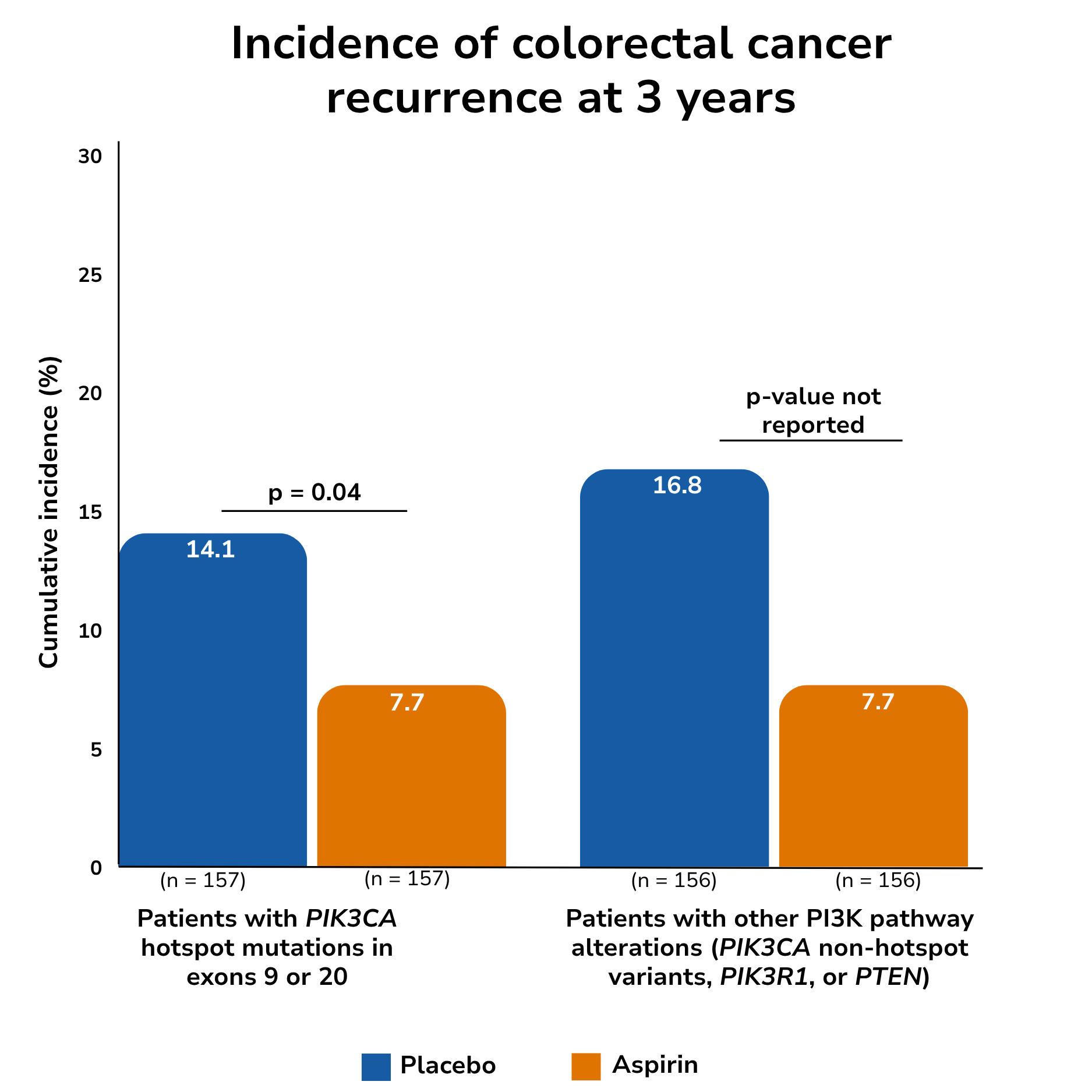
In the ALASCCA randomized controlled trial, aspirin was associated with a lower incidence of recurrence in patients with resected stage I–III rectal cancer or stage II–III colon cancer with PI3K pathway alterations compared with placebo.3
See more details about ALASCCA below.
ALASCCA: Adjuvant Low-Dose Aspirin in Colorectal Cancer3
Martling et al., N Engl J Med, 2025
ALASCCA was a phase 3, randomized, double-blind, placebo-controlled trial evaluating daily adjuvant aspirin (160 mg) for 3 years in 626 patients with resected stage I–III rectal cancer or stage II–III colon cancer with PI3K pathway alterations across Sweden, Norway, Denmark, and Finland. Patients were stratified into two groups:
Group A: patients with prespecified PIK3CA hotspot mutations in exons 9 or 20
Group B: patients with other PI3K pathway alterations (PIK3CA non-hotspot variants, PIK3R1, or PTEN)
In patients with PIK3CA hotspot mutations, the 3-year cumulative incidence of recurrence was 7.7% in those receiving aspirin and 14.1% in those receiving placebo (HR 0.49, 95% CI 0.24–0.98, p = 0.04). In patients with other PI3K pathway alterations, the 3-year cumulative incidence of recurrence was 7.7% in the aspirin group and 16.8% in the placebo group (HR 0.42, 95% CI 0.21–0.83).
Adverse events were more common with aspirin than placebo, including severe adverse events; four severe adverse events and one death were considered potentially aspirin-related.
These limitations should be considered when evaluating the data:
The patient population may have been healthier than the general colorectal cancer population.
The trial was not adequately powered to evaluate alternative doses, treatment durations, or subgroup effects.
Study sponsor: The study was supported by grants from the Swedish Research Council, Swedish Cancer Society, Cancer Research Funds of Radiumhemmet, ALF (regional agreement grant between Karolinska Institutet and Region Stockholm, 2016–2024), Danish Comprehensive Cancer Center, and private donors (B. Carlson family, B. Lehander family, and B. Savén family).
SAKK 41/13: Adjuvant Aspirin Treatment in PIK3CA-Mutated Colon Cancer Patients4
Güller et al., Clin Cancer Res, 2025
SAKK 41/13 was a multicenter, phase 3, randomized, double-blind, placebo-controlled trial evaluating daily adjuvant aspirin (100 mg) for 3 years in 112 patients with resected stage II–III colon cancer with PIK3CA mutation in exons 9 or 20.
Disease-free survival rates were 88.3% versus 82.4% at 3 years and 86.5% versus 72.9% at 5 years for aspirin and placebo, respectively. The unstratified HR for disease-free survival was 0.57 (90% CI 0.27–1.22, p = 0.11).
Grade 3 treatment-emergent adverse events occurred in 1 patient receiving aspirin and in 3 patients receiving placebo. No aspirin-related serious adverse events were reported.
This limitation should be considered when evaluating the data:
The study was closed prematurely due to financial constraints, resulting in a small sample size and limited statistical power.
Study sponsor: Supported by the Swiss National Foundation, Swiss Cancer League, a grant for Oncology Innovation (Merck), Promedica Stiftung, and Fédération Francophone de la Cancérologie Digestive (FFCD). Aspirin and placebo were provided by Bayer. The study was conducted in collaboration with the European Organisation for Research and Treatment of Cancer.
PRODIGE 50-ASPIK: Aspirin Versus Placebo in Stage III or High-Risk Stage II Colon Cancer With PIK3CA Mutation5
Michel et al., Dig Liver Dis, 2018 (protocol)
Trial recruitment opened in December 2018; Expected to be completed in June 20286
PRODIGE 50-ASPIK is a phase 3, randomized, double-blind, placebo-controlled trial evaluating daily aspirin (100 mg) for 3 years or until recurrence in patients with resected stage III or high-risk stage II PIK3CA-mutated colon cancer in France. Randomization will be stratified according to four factors: (1) treatment center, (2) stage II versus III, (3) RAS mutation status, and (4) chemotherapy with oxaliplatin versus no oxaliplatin.
The primary endpoint is 3-year disease-free survival. Secondary endpoints include 5-year disease-free survival, 5-year overall survival, grade 3–4 bleeding events requiring hospitalization, adverse events, treatment compliance, and subgroup analyses by mutation status (RAS, BRAF) for disease-free and overall survival.
Study sponsor: Funded by the Programme Hospitalier de Recherche Clinique and Fédération Francophone de Cancérologie Digestive (FFCD). The Ligue contre le cancer provided financial support to FFCD. Bayer will support the study by providing aspirin and placebo.
Meta-Analyses
Eight published meta-analyses have evaluated aspirin in patients with PI3K-altered colorectal cancer, primarily focused on PIK3CA mutations. The meta-analyses summarized here include studies with variability in design, definitions of aspirin exposure, patient populations, and follow-up durations, contributing to heterogeneity in pooled results.
Blanchard-Cavagis et al., Crit Rev Oncol Hematol, 20267
More details
Lin et al., BMC Cancer, 20209
More details
Paleari et al., Clin Oncol (R Coll Radiol), 201611
More details
Mei et al., Ann Oncol, 201612
More details
Lenz et al., Clin Colorectal Cancer, 20258
More details
Elwood et al., PLoS One, 201610
More details
Ye et al., Br J Cancer, 201414
More details
Li et al., Gut, 201513
More details
Observational Studies
Nine published observational studies have evaluated aspirin use in patients with PI3K-altered colorectal cancer; these studies have specifically evaluated patients with PIK3CA mutations. Observational studies can identify associations but generally cannot establish causality, and findings may be influenced by confounding factors, including differences between patients who do and do not receive a treatment. No safety outcomes were reported in any of the studies.
References:
1. National Comprehensive Cancer Network. NCCN Clinical Practice Guidelines in Oncology: Colon Cancer. Version 2.2026. Published April 7, 2026. Accessed April 7, 2026. 2. National Comprehensive Cancer Network. NCCN Clinical Practice Guidelines in Oncology: Rectal Cancer. Version 2.2026. Published April 7, 2026. Accessed April 7, 2026. 3. Martling A, et al. N Engl J Med. 2025;393(11):1051–64. 4. Güller U, et al. Clin Cancer Res. 2025; 31(15):3142–49. 5. Michel P, et al. Dig Liver Dis. 2018;50(3):305–7. 6. European Medicines Agency. EU clinical trials register: search results for EUCT 2024-516007-16-00. Accessed March 17, 2026. https://euclinicaltrials.eu/search-for-clinical-trials/?lang=en&EUCT=2024-516007-16-00 7. Blanchard-Cavagis ER, et al. Crit Rev Oncol Hematol. 2026;220:105167. 8. Lenz G, et al. Clin Colorectal Cancer. 2025;24(4):415-424.e2. 9. Lin JL, et al. BMC Cancer. 2020;20(1):681. 10. Elwood PC, et al. PLoS One. 2016;11(4):e0152402. 11. Paleari L, et al. Clin Oncol (R Coll Radiol). 2016;28(5):317–26. 12. Mei ZB, et al. Ann Oncol. 2016;27(10):1836–48. 13. Li P, et al. Gut. 2015;64(9):1419–25. 14. Ye XF, et al. Br J Cancer. 2014;111(11):2172–9. 15. Gebauer L, et al. Cancers. 2021;13(19):4959. 16. Murphy C, et al. Intern Med J. 2017;47(1):88–98. 17. Gray RT, et al. Clin Transl Gastroenterol. 2017;8(4):e91. 18. Hamada T, et al. J Clin Oncol. 2017;35(16):1836–44. 19. Kothari N, et al. Acta Oncol. 2015;54(4):487–92. 20. Reimers MS, et al. JAMA Intern Med. 2014;174(5):732–9. 21. Nishihara R, et al. JAMA. 2013;309(24):2563–71. 22. Domingo E, et al. J Clin Oncol. 2013;31(34):4297–305. 23. Liao X, et al. N Engl J Med. 2012;367(17):1596–606.
Subscribe to receive updates on Reboot Rx and our work on aspirin.
Reboot Rx is a registered 501(c)(3) nonprofit organization. Reboot Rx does not manufacture or sell drugs, and does not profit from the sale of drugs. Information provided on the Reboot Rx website (the “Information”), available at http://rebootrx.org (the “Site”), is intended for U.S. healthcare professionals only and not intended for patients. Information available on this Site is intended for informational purposes only and is not intended to provide medical advice and should not be relied upon in that regard. Reboot Rx provides this Information as an educational resource for the benefit of the medical community. The Information on this website has not been evaluated by the Food and Drug Administration. Reboot Rx is not a medical provider or health care facility and does not practice medicine. It thus can neither diagnose any disease or disorder, nor endorse or recommend any specific medical treatments. Nothing on this Site constitutes medical advice, recommendations as to the suitability of any specific product, service or information, or diagnoses for any medical condition. Any materials made available via the Site are provided for convenience and informational purposes only. Any clinician seeking to apply or consult the content and/or derivative sources on this website must use their independent medical judgment in the context of the individual clinical circumstances to determine any patient’s care or treatment.